The Carbon Credit Management Program (CCMP): from climate policy and project design to MRV, registries, finance and integrity.
India’s Carbon Credit Trading Scheme and the EU’s CBAM are turning carbon credits into regulated, priced assets. Learn how a credit is created, verified, priced and defended by building the work yourself, taught live by a practising CFA.
Phase certificates and the CCMP designation on completion.
Enrol now · secure your seat →
*Limited festive offer. Refund window: 7 days from Day 1, if you attended all sessions and completed all labs. Outcomes vary and are not guaranteed.
Both are valuable. They answer different jobs, so choose by the work you want to do.
₹19,999 · 4 weeks · Excel
Calculate Scope 1, 2 and 3, build an audit-ready inventory and a net-zero roadmap. Choose this if your job is a company’s emissions data.
₹54,999* · 12 weeks · live every weekend
Design a credit project, plan MRV, trace issuance, run due diligence, price and account for credits under CCTS, voluntary markets and CBAM. Choose this if your job is creating, buying, selling or assuring credits.
Most learners take the GHG Bootcamp first, then CCMP. The two do not overlap: CCMP uses only the baseline accounting a project needs.
A registry issuance proves a project passed an administrative process. It does not prove a buyer should buy it, at any price, or make any claim with it. Credits hold up only if every link, from the physical activity to the retired serial number, can be reconstructed.
The programme trains you to build that chain as a project developer, test it as a buyer or verifier, and price the risk when a link is weak.
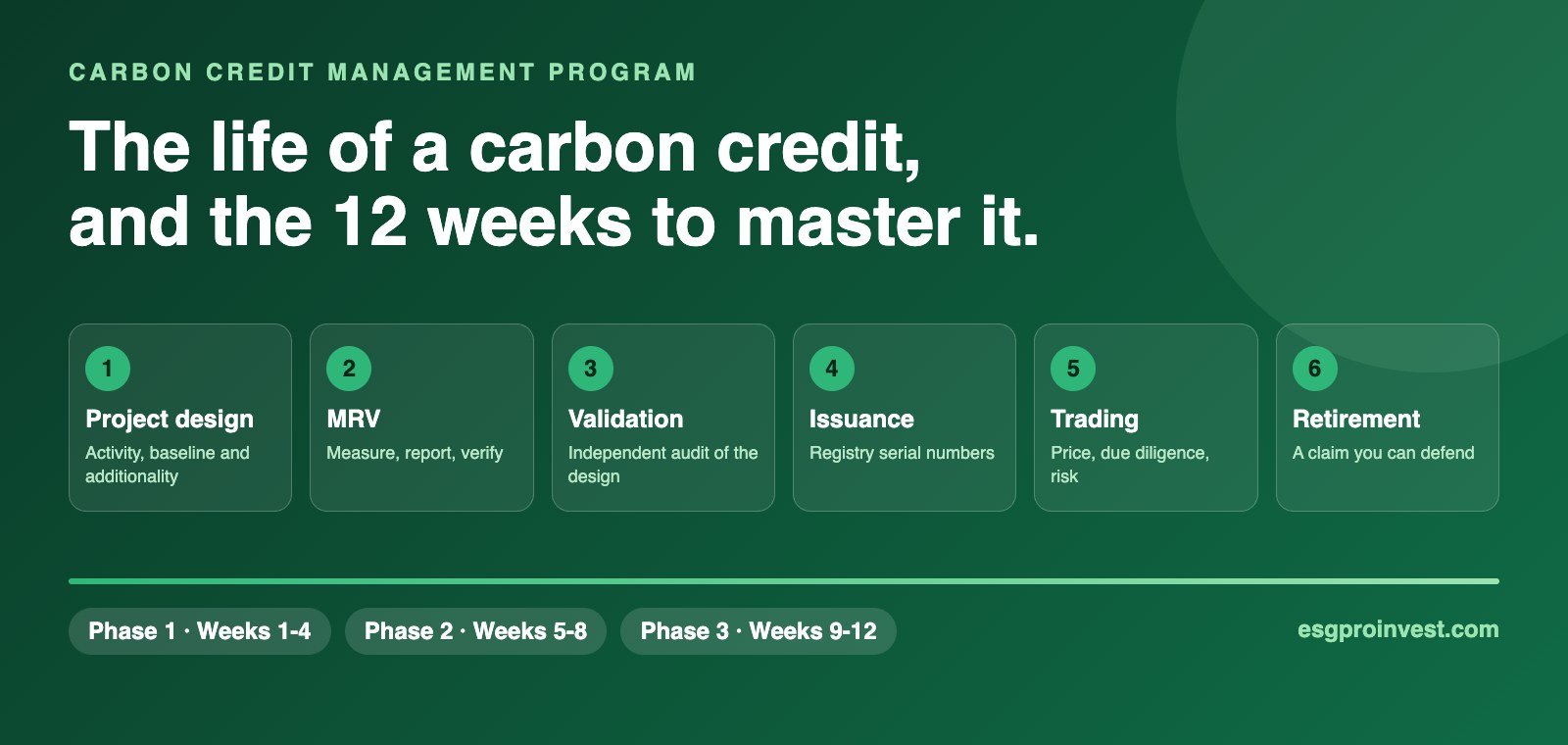 The eleven links you learn to test
The compliance carbon market: how credits are issued, traded and surrendered.
Registries, methodologies and integrity questions behind project credits.
Carbon cost on exports, and what it means for credits, pricing and compliance.
Eleven modules, built into one weekly sequence. Each phase ends in an assessment and a certificate; the CCMP designation is awarded on the capstone. Scroll to follow the cohort.
Builds: Policy and market map
Builds: Project design document draft; Phase 1 assessment
Builds: MRV plan
Builds: Issuance trace
Builds: Credit quality scorecard; Phase 2 assessment
Builds: Credit due-diligence memo; CBAM model
Builds: Portfolio simulation; Phase 3 assessment and CCMP designation
Saturday and Sunday
About 6 live hours a week, taught by faculty.
Included
Every session is recorded for anyone who misses it.
10+ project works
Labs and assignments with faculty feedback.
Week 12
Present to faculty and guest reviewers.
The artefacts a project developer, buyer or advisory team asks to see.
A credit project from baseline and additionality to monitoring plan.
A measurement plan and a trace from activity data to registry serial.
A decision-grade memo with risks, red flags and a price view.
A compliance-cost model for an exporter and a simulated credit portfolio.
Screens projects, credits and counterparties for a developer, fund or buyer.
Prepares project design documents and manages MRV and issuance.
Owns carbon cost exposure and compliance for an exporter.
Buys credits and has to defend the claim to the board and auditors.
Prices carbon risk, advises clients and builds a carbon practice.
Moving into carbon markets from engineering, finance or EHS.
Finance, compliance, engineering, EHS and ESG professionals and career changers who want to work with carbon credits and markets.
Anyone who only needs to calculate a company’s emissions (start with the GHG Bootcamp), who wants ESG reporting in depth (see Agentic AI for ESG Reporting), or who wants a certificate without doing the work.

Viveck Jai Suman, CFA, founder of ESGPro Mastery Institute, has 22+ years across corporate finance, transaction advisory and sustainability. He advises companies in India, Oman and Saudi Arabia and has authored two books, so every example comes from reporting work he has actually run.
Live sessions are taught directly and never delegated to teaching assistants. Every case comes from engagements he has actually run.
Capped because reviewed project work and office hours do not scale past it.
One payment. Next cohort: Second week of December 2026.
Ask before you apply.
Invoiced to the company.
*Limited festive early-bird offer on this cohort while seats last; standard fee ₹74,999. All fees exclude GST.
Full refund on written request within 7 days of Day 1, if you attended all sessions and completed all labs. See the Terms of Use.
Not sure yet? The ₹299 live webinar shows the market, the roles and your roadmap. See the webinar.
We check the fit against the work you want to do and confirm your seat and the next cohort date.
Please verify the current fee and payment destination before transferring. Certificates and the CCMP designation are issued by ESGPro and are not credentials of any registry, regulator or standard-setting body.
The GHG Bootcamp (₹19,999, 4 weeks) teaches you to calculate and defend a corporate emissions inventory. The Carbon Credit Management Program (12 weeks) teaches you to create, verify, assess, price and account for carbon credits. It revisits GHG accounting only as far as project baselines need, so you do not repeat the bootcamp.
CCMP is the Carbon Credit Management Program. ESGPro issues a certificate after each of the three phases and the Carbon Credit Management Professional (CCMP) designation on completing the programme and the capstone. These are ESGPro credentials, not issued by any registry, regulator or standard-setting body.
Live classes run every Saturday and Sunday, about 6 live hours a week, for 12 weeks. Every session is recorded and shared, so you can catch up on anything you miss. Plan on 10+ project works across the programme on top of class time.
The next cohort starts in the Second week of December 2026. The early-bird fee is ₹54,999 excluding GST* and includes live weekend classes, recordings, 12+ live case studies and simulations, project work with feedback, calculators and templates, an alumni community and your credentials.
No. The programme builds from first principles, and finance, compliance, engineering and EHS professionals all follow it. You should be comfortable with spreadsheets and reading technical documents.
Not in depth. This programme is about carbon credits and carbon markets. For end-to-end ESG reporting with AI, including BRSR, GRI and IFRS S1 and S2, see Agentic AI for ESG Reporting.
A project design document, an MRV plan with an issuance trace, a carbon credit due-diligence memo, a CBAM exposure and compliance-cost model, a portfolio simulation and a capstone, among 10+ project works.
Under the Cancellation and Refund Policy in our Terms of Use, you can request a full refund in writing to info@esgproinvest.com within 7 days of the first live session (Day 1), provided you attended all sessions held and completed all labs and assignments set up to the date of your request. After that window, fees are non-refundable.
No. Outcomes vary with the work you submit, your background and the market, and are not guaranteed. The programme guarantees that you will have produced the work yourself.
Join the Carbon Credit Management Program and develop practical expertise in carbon accounting, carbon markets and climate finance. Twenty seats per cohort.
Stay in the loop
New guides on ESG reporting, carbon accounting and sustainable finance, plus dates for the Sunday 3:30 PM webinar. No spam, unsubscribe any time.